
Share This Article
Summary
SERP Insight link insertion is the practice of placing your backlink inside an existing, already-ranked, high-traffic article on an authoritative website — rather than creating new content from scratch. It delivers faster SEO results because the page is already indexed and trusted by Google. Compared to guest posting, it costs significantly less (average $141 vs $365 per link), requires no content creation, and can show ranking movement within 6–12 weeks. However, it only works when the placement is contextually relevant and on a genuinely high-quality page. Done wrong, it can trigger algorithmic penalties.
What Is SERP Insight Link Insertion? (Clear Definition)
SERP Insight link insertion is a targeted SEO link-building strategy where a backlink pointing to your website is inserted — as contextual anchor text — inside an existing published article that already ranks on the first or second page of Google’s search results.
The term combines two distinct concepts: SERP Insight (using data from the Search Engine Results Page to identify already-ranking, high-authority content) and link insertion (also called a niche edit — the act of placing a new backlink inside old, live content without writing a new article).
Unlike guest posting — where you write a brand new article to earn a link — link insertion works by finding pages that Google already trusts and adding your link contextually within them.
The result: your site inherits authority signals from a page that has already proven its value to search engines.
Why SERP Insight Link Insertion Has Grown in 2025–2026
The SEO landscape shifted dramatically in late 2024 and throughout 2025. Google’s algorithm updates placed increasing emphasis on contextual relevance, editorial authority, and natural link patterns.
According to a 2025 analysis by AllOutSEO, 85.3% of guest post sites are classified as low-quality, with weak authority and minimal traffic. At the same time, the cost of quality link building has been rising sharply — the average cost of a premium guest post now ranges between $692 and $957, while top-tier placements exceed $3,000.
This cost pressure pushed SEOs toward a more efficient alternative: instead of paying to create new content on new pages with no existing authority, they began targeting pages that already rank — and inserting links there.
Since the content is already indexed and trusted, SERP Insight link insertion tends to provide faster and more consistent SEO signals than approaches which depend on newly published pages.
How SERP Insight Link Insertion Actually Works (Step-by-Step)
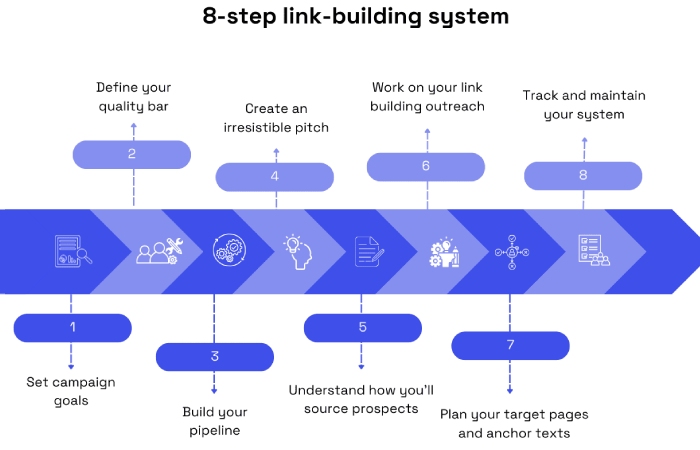
Step 1: Identify Target Keywords and Competing Pages
Start by searching your target keyword in Google. Focus on pages ranking in positions 1–30 — these are the pages Google already trusts for that topic.
Tools like Ahrefs, Semrush, or SE Ranking help you filter by organic traffic, number of referring domains, and Domain Rating (DR). You’re looking for pages that:
- Are already getting real organic traffic (not just DR metrics)
- Are topically relevant to your website’s niche
- Have editorial-style writing, not promotional or thin content
- Have not been over-optimized with too many external links already
Step 2: Prioritise Page-Level Relevance Over Domain Authority
This is the step most beginners skip — and it’s the most important one.
Domain authority alone is misleading. SERP Insight prioritizes page relevance. If the page supports your topic naturally, it qualifies. Use SEO tools to confirm the page gets organic traffic. Ranking keywords indicate trust.
A DR 40 page that ranks for your exact topic and gets 3,000 monthly visitors is far more valuable than a DR 80 site where the specific page has zero traffic.
Step 3: Qualify the Page for Editorial Flexibility
Not every high-ranking page will accept an insertion. You need:
- A webmaster or publisher willing to update existing content
- A natural gap in the article where your link adds genuine value (a missing statistic, a helpful tool reference, a deeper resource)
- A page that doesn’t already link out to a direct competitor in that exact position
Step 4: Craft the Right Anchor Text
Anchor text is critical. Search engines have taken semantic relevance and contextual authority into consideration. The links are no longer considered separately — they are evaluated on the basis of their location, their connection with the surrounding text, and whether they are actually helpful to the users.
Best practices for anchor text in 2026:
- Use descriptive, natural phrases (e.g. “complete guide to on-page SEO”)
- Vary anchor text across different insertions — avoid repeating the same phrase
- Never use exact-match commercial anchors repeatedly (e.g. “buy cheap backlinks”)
- Match the tone of the existing article
Step 5: Negotiate and Execute the Placement
Outreach to the publisher, content manager, or site owner. Your pitch should focus on the editorial value your link adds — not on the SEO benefit to you.
Provide the exact sentence or paragraph where the link fits naturally. This increases acceptance rates and ensures the insertion reads organically.
Step 6: Monitor Results
Track keyword rankings, referral traffic, and link indexation status after placement. SERP link insertions typically show results after around 6 to 12 weeks — after the link-inserted pages are crawled, indexed, and evaluated by search bots.
SERP Insight Link Insertion vs Guest Posting: Which Is Better?

This is the question every SEO manager in India faces when allocating link-building budget.
| Factor | SERP Insight Link Insertion | Guest Posting |
|---|---|---|
| Content required | No — uses existing articles | Yes — full article needed |
| Time to results | 6–12 weeks | 3–6 months (new page indexing) |
| Average cost per link | ~$141 (₹11,700 approx.) | ~$365–$957 (₹30,000–₹80,000) |
| Authority signal | Page-level trust (immediate) | Domain-level (delayed) |
| Control over content | Moderate | High |
| Risk of Google penalty | Low (if relevant) | Low (if quality) |
| Best for | Faster ranking boosts | Brand authority building |
| Indexing risk | Minimal (page already indexed) | Higher (new page may not index) |
Data context: the average price for a link insertion is about $141, while guest posts average $365 — with high-quality posts averaging $930 based on traffic and DA/DR benchmarks.
There’s also a significant indexing risk with guest posts that most articles ignore. A study by SEO expert Sergei Prakapovich found that by 2025, only 126 out of 203 guest posts placed in January 2024 remained indexed — meaning about 10% of guest posts disappeared from Google’s index over a single year.
Link insertions don’t carry this risk because the host page is already indexed and receiving traffic.
The verdict: Neither strategy wins outright. Niche edits eliminate content creation costs since links are inserted into existing articles, with pricing generally 20–30% lower than guest posts. However, guest posts often justify higher investment through added brand exposure and long-term authority value.
For most Indian SEO campaigns with limited budgets, starting with SERP Insight link insertions and supplementing with selective guest posts is the most efficient approach.
Real Benefits of SERP Insight Link Insertion
- Faster indexing — the host page is already crawled regularly by Google
- Immediate authority transfer — you inherit trust from an established, ranked page
- No content creation cost — saves 60–80% of typical guest post investment
- Lower outreach rejection rates — you’re offering editorial value, not asking for real estate
- Scalable — once you identify quality pages in your niche, the process repeats efficiently
- Works in competitive niches — especially effective for technology, finance, health, and e-commerce keywords
Real Risks and How to Avoid Them
SERP Insight link insertion is not without downsides. Used carelessly, it can actively harm your rankings.
Risk 1: Irrelevant placements Inserting your link on a page that doesn’t match your topic sends confusing signals to Google. A link to a digital marketing tool placed inside a recipe blog article is a classic example of a penalisable, contextually irrelevant insertion.
Risk 2: Over-optimised anchor text Repeating the same exact-match anchor across multiple insertions is a known algorithmic red flag. Vary your anchors naturally.
Risk 3: Low-quality or spammy source pages Some link sellers offer insertions on pages that look authoritative by metrics but receive no real traffic. Always verify organic traffic via Ahrefs or Semrush — not just DA/DR scores.
Risk 4: Too many insertions too quickly It is generally safe to use around 1 to 3 high-quality SERP Insight link insertions per article. Scaling too fast creates unnatural link velocity patterns that modern algorithms detect.
Risk 5: Ignoring page updates An inserted link can lose value if the host page is later updated, redirected, or noindexed. Monitor your backlinks monthly using Google Search Console or a dedicated backlink tracker.
Who Should Use SERP Insight Link Insertion?
Ideal for:
- Websites targeting competitive keywords in established niches (tech, finance, health, SaaS)
- SEO agencies managing multiple client campaigns with limited per-client budgets
- Indian businesses that need faster ranking results without spending ₹50,000–₹80,000 per guest post
- Sites that already have good on-page SEO but lack sufficient backlink authority
- E-commerce stores trying to rank category and product pages faster
Not ideal for:
- Brand-new websites with no existing content or topical authority (Google needs some base signals before link insertions become effective)
- YMYL (Your Money or Your Life) sites in finance, health, or legal — where Google’s E-E-A-T standards require authored, attributed content and guest posts carry more weight
- Anyone expecting overnight results — even fast link insertions require 6–12 weeks of crawl-index-evaluate cycles
How Many Link Insertions Do You Need Per Keyword?
There’s no fixed number, but here’s a practical framework:
| Keyword Difficulty | Recommended Insertions | Timeline |
|---|---|---|
| Low (KD 0–20) | 2–5 high-quality insertions | 4–8 weeks |
| Medium (KD 21–50) | 5–15 insertions + 2–3 guest posts | 8–16 weeks |
| High (KD 51–70) | 15–30 insertions + ongoing guest posts | 4–8 months |
| Very High (KD 71+) | Advanced link strategy needed | 6–12+ months |
The quality of each page matters far more than the number. Two insertions on genuinely ranked, high-traffic pages will outperform 20 insertions on low-traffic DA-stuffed blogs.
Common Mistakes Indian SEOs Make With Link Insertion
Choosing sites purely by DA/DR. Metrics like Domain Authority (Moz) and Domain Rating (Ahrefs) are third-party estimates — not Google signals. A site with DA 60 and zero organic traffic passes on almost no real SEO value.
Not checking if the page already has too many outbound links. A page with 50 external links already distributes its link equity very thinly. Aim for pages with fewer than 10–15 outbound links where possible.
Using the same anchor text across every insertion. This is the fastest path to a manual penalty. Each insertion should use a distinct, descriptive anchor phrase.
Paying for insertions without checking content quality. The surrounding text matters. A link stuffed into a paragraph of thin, AI-generated content is devalued by Google’s quality assessment systems.
Not tracking results. Without monitoring rankings and referral traffic after insertions, you can’t identify what’s working and scale it — or identify a bad placement and disavow it.
Myths vs. Facts: SERP Insight Link Insertion
Myth: Link insertion is a black-hat SEO technique. Fact: Contextual link insertion within relevant, high-quality pages is a fully white-hat tactic when done editorially. Google’s guidelines penalise manipulative link schemes — not editorially placed contextual references that genuinely help readers.
Myth: The older the page, the better the link. Fact: Page age matters less than ongoing traffic. An old page that hasn’t been updated and now receives no organic visitors passes minimal link equity regardless of its age.
Myth: One or two link insertions will fix rankings quickly. Fact: Link insertions are one signal among many. On-page SEO, content quality, Core Web Vitals, and topical authority all contribute to rankings. Insertions accelerate progress — they don’t replace foundational SEO work.
Myth: All link insertion services are the same. Fact: Quality varies enormously. The differentiating factor is whether a provider places links on pages with verified organic traffic and editorial relevance — or on link farms with inflated metrics and no real visitors.
Practical Tips for Getting the Most Out of Link Insertions in 2026
- Always verify organic traffic on the specific URL — not just the domain — before paying for any insertion
- Target pages that already rank for keywords semantically related to your target keyword
- Request to see where exactly the link will be placed before confirming payment
- Diversify your link profile — mix insertions with digital PR, resource page links, and selective guest posts
- Use Google Search Console to monitor which inserted links are actually being crawled and passing signals
- Prioritise dofollow links, but a handful of contextual nofollow links from highly authoritative pages also adds natural diversity to your backlink profile
- In India, many publishers are open to link insertions in exchange for reciprocal exposure rather than cash — explore content collaboration arrangements before assuming paid-only routes
FAQs
Q1: What is SERP Insight link insertion?
SERP Insight link insertion is the practice of placing a contextual backlink inside an existing, already-indexed, high-ranking article on another website. It uses SERP data (what’s already ranking) to identify the best pages for placement, then inserts your link naturally within the existing content — without creating a new article.
Q2: Is SERP Insight link insertion safe for SEO?
Yes, when done correctly. Links inserted into genuinely relevant, high-traffic pages with natural anchor text are safe and effective. The risk comes from irrelevant placements, over-optimised anchors, or low-quality source pages. Done with proper quality checks, it is a white-hat, Google-compliant tactic.
Q3: How long does SERP Insight link insertion take to show results?
Most SEOs see initial ranking movement within 6–12 weeks of a link being inserted, as the host page is re-crawled and the new link is evaluated. Significant, measurable ranking improvement is typically observed over 3–6 months with consistent quality placements.
Q4: How much does SERP Insight link insertion cost?
Industry data from BuzzStream (2025) puts the average link insertion cost at approximately $141 per link — significantly lower than guest posts, which average $365–$957 for quality placements. Cost varies based on the traffic, DR, and niche of the host page.
Q5: How is link insertion different from guest posting?
Guest posting creates a new article on another website to earn a backlink. Link insertion places your link inside an already-published, ranked article. Link insertion is faster (no content creation needed), cheaper, and shows results more quickly — but guest posts offer more editorial control and are better for brand authority in YMYL niches.
Q6: How many link insertions should I do per keyword?
For low-to-medium difficulty keywords, 2–15 quality insertions over 8–16 weeks is a reasonable starting point. For highly competitive keywords, a combination of link insertions and guest posts over 4–8 months is more appropriate. Quality and relevance always outweigh quantity.
Q7: What makes a page ideal for SERP Insight link insertion?
An ideal host page already ranks in the top 1–30 positions for a relevant keyword, receives verified organic traffic (confirmed via Ahrefs or Semrush), is topically relevant to your content, has editorial-style writing, and doesn’t already contain excessive outbound links or links to direct competitors in your space.
Final Conclusion
SERP Insight link insertion is one of the most cost-efficient, practically sound, and scalable SEO strategies available to website owners and digital marketers in 2026 — particularly for Indian businesses operating with mid-level link-building budgets.
By targeting pages that Google already trusts, you skip the long wait for new content to get indexed and ranked. You place your authority signal precisely where it already carries weight — inside live, ranked, relevant articles.
The key is discipline: relevance over volume, page-level traffic over domain metrics, varied anchor text over repetition, and quality outreach over bulk purchasing.
Used strategically alongside strong on-page SEO and selective guest posting, SERP Insight link insertion can move your rankings faster, more predictably, and at a fraction of the cost of most alternative approaches. It’s not a shortcut — it’s a smarter path to the same destination.