


Share This Article
No other line item in a growing business gets treated with the fatalism that IT spending does. Marketing has a budget and a plan. Payroll has a budget and, obviously, a plan. But IT often runs on something closer to weather forecasting: a vague sense that money will need to be spent eventually, on something, probably soon, and everyone just waits to find out what and how much. Then a server fails on a Wednesday, a laptop fleet ages out all at once, or a ransomware attempt gets uncomfortably close, and suddenly there is an emergency invoice nobody budgeted for and a Slack message asking who approved this. That is not a strategy. That is a business letting its technology spending be run by chance.
The strange part is how normalized this has become. Ask a founder about their marketing spend and they can walk you through channel by channel. Ask about their IT spend and you often get a shrug and a number that changes every quarter for reasons nobody can fully explain. If you have ever priced out Calgary managed IT services and felt a small wave of relief at seeing one flat monthly number instead of a maze of tiers and asterisks, that reaction alone tells you something about how unusual predictable IT pricing has become for a lot of business owners.
Here is the actual absurdity, laid out plainly. A company will spend months negotiating a lease, modeling cash flow scenarios, and stress-testing a marketing budget down to the dollar, then treat its own technology infrastructure, the thing every other department depends on to function at all, as an unplanned cost center that gets dealt with only when it breaks. It is the equivalent of never budgeting for vehicle maintenance and being shocked, every single time, that the transmission eventually needs work.
The businesses getting this right have made one conceptual shift: they stopped thinking about IT as a repair bill and started thinking about it as a fixed operating cost, the same category as rent or insurance. That shift changes the entire conversation with a provider. Instead of “what will this cost when something breaks,” the question becomes “what does it cost to keep this from breaking in the first place, and what’s included for that price.” It is a smaller mental leap than it sounds like, but almost nobody makes it until a bad enough surprise forces the issue.
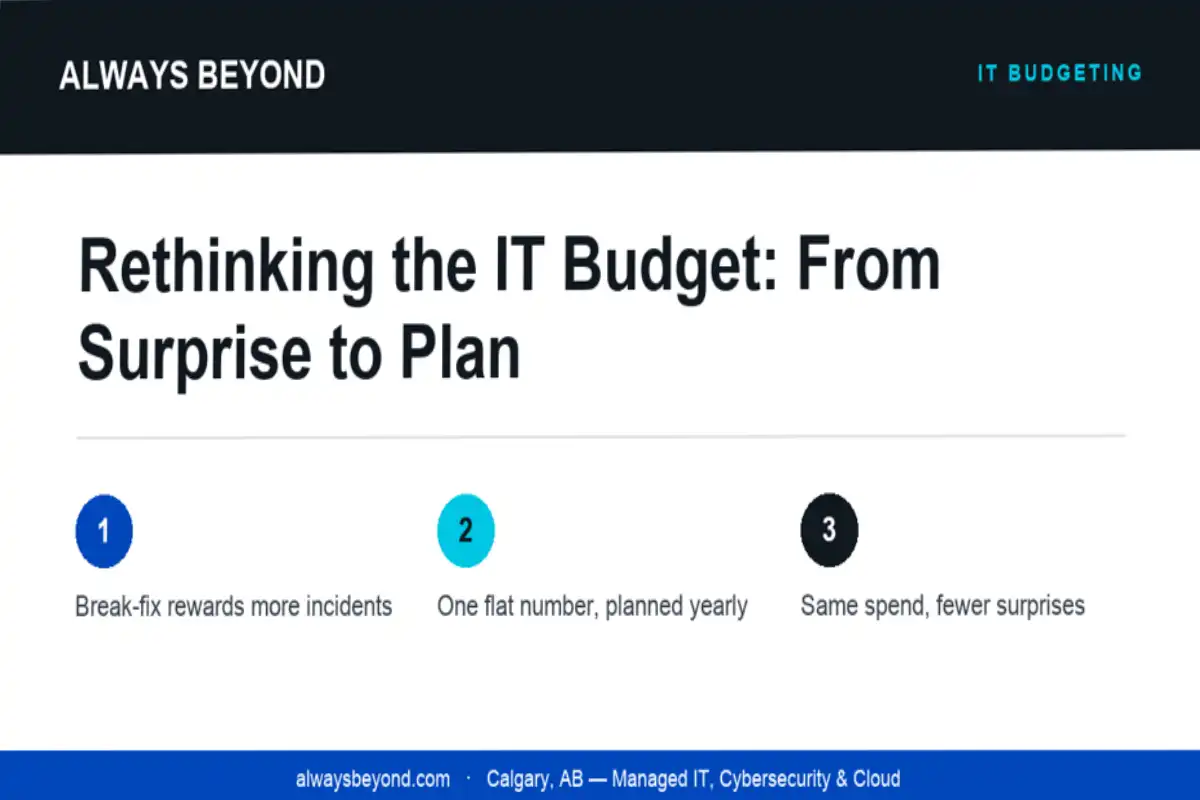
A genuinely predictable model tends to share a few traits worth checking for before you sign anything: one flat monthly fee rather than a base price with a long list of exclusions, no multi-year contract holding you hostage to a decision made under pressure, and a scope broad enough that “is this covered” is rarely a question you have to ask out loud. Contrast that with the alternative, an hourly break-fix arrangement, where the incentive structure is quietly backwards: the provider gets paid more when things go wrong, and you are financially better off the less you call them, which is a strange position to put a support relationship in.
None of this requires a bigger budget, just a different shape to it. Most businesses discover their new predictable number is close to what they were already spending, they just used to spend it in a panic instead of in a plan. The employee-owned team at Always Beyond builds its pricing around exactly this idea: one package, one number, no surprise invoice waiting in a drawer.
There is a trust question buried in all of this too. A break-fix provider profits most when your systems are unreliable. A flat-fee provider profits most when your systems just quietly work, month after month, without drama. Those are not similar incentive structures wearing different labels, they point in opposite directions, and it is worth asking any prospective provider which one they actually operate under before signing anything longer than a few pages.
Growing businesses that get this right also treat the annual planning conversation differently. Instead of an IT line item buried under “miscellaneous,” technology spend gets its own review, alongside marketing and payroll, with its own questions: what changed this year, what is coming next, and what would readiness actually cost.
Budget for IT the way you budget for anything else you actually depend on. Waiting for the next outage to decide what technology is worth to your business is not a philosophy. It is just procrastination with better branding.