
Share This Article
The air fryer has gone from a niche kitchen gadget to one of India’s fastest-selling home appliances — and for good reason. But with dozens of brands, confusing specs, and bold health claims floating around, most buyers are still unsure whether it actually lives up to the hype.
This guide cuts through all of it. Whether you’re buying your first air fryer or upgrading to a better one, you’ll find everything you need right here.
What Is an Air Fryer? (Clear Definition)
An air fryer is a countertop kitchen appliance that cooks food by circulating superheated air at high speed around the food using a powerful fan and a heating element — a technique known as Rapid Air Technology.
The result: food that is crispy on the outside, tender on the inside, with little to no added oil.
An air fryer is essentially a compact, high-powered convection oven designed to mimic the texture and taste of deep-fried food — using up to 70–80% less oil.
It was first introduced commercially by Philips in 2010 and has since become a global kitchen staple. In India, air fryer sales have grown by over 45% year-on-year between 2022 and 2025, driven by rising health consciousness and urban cooking habits.
How Does an Air Fryer Work?
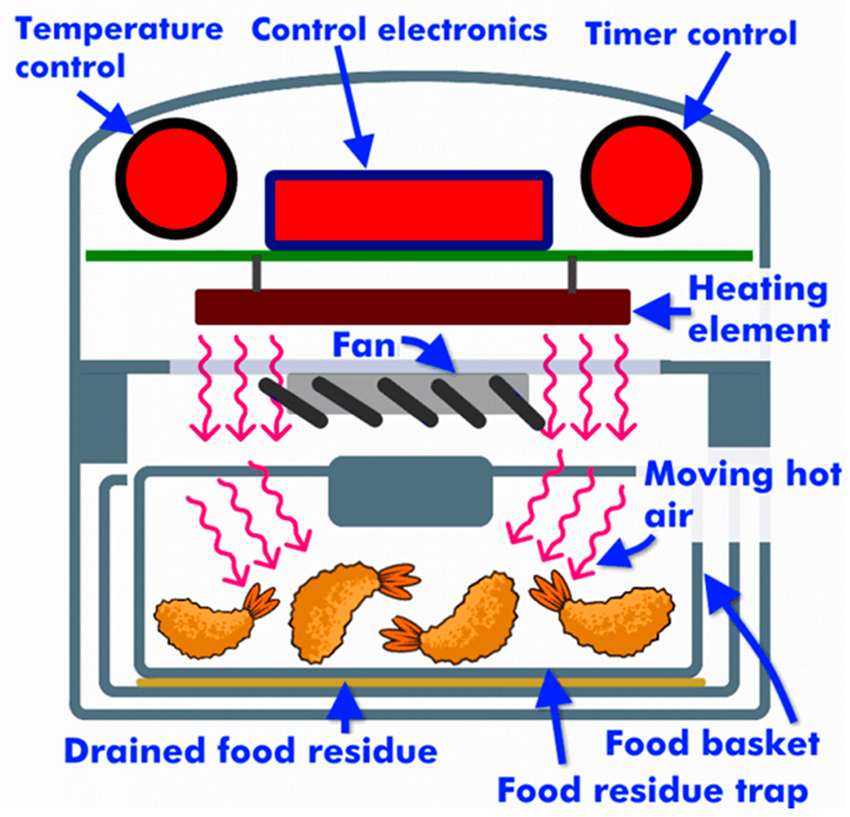
Here’s the science in simple terms:
When you place food in the air fryer basket and set the temperature (typically between 150°C and 230°C), the appliance does three things simultaneously:
1. Heats up rapidly — The heating coil at the top reaches cooking temperature within 2–3 minutes.
2. Circulates hot air — A high-speed fan pushes the hot air in a 360° pattern around the food.
3. Creates the Maillard reaction — This is the same chemical process that gives deep-fried or oven-baked food its golden-brown, crispy crust — without submerging food in oil.
The combination means your samosas, french fries, or chicken tikka cook evenly, quickly, and with a fraction of the oil.
Who Should Buy an Air Fryer?
This appliance is ideal for:
- Health-conscious individuals and families trying to reduce oil intake
- Working professionals who want quick, fuss-free cooking
- Fitness enthusiasts tracking calorie and fat consumption
- Small families (2–4 members) in urban apartments
- People who frequently cook snacks like pakoras, fries, nuggets, or kebabs
- Seniors who find deep frying messy or unsafe
Who should think twice before buying:
- Large joint families (6+ members) — most standard air fryers have 3.5L–5.5L capacity, which may require multiple batches
- Those who cook primarily curries, dal, or liquid-based dishes — an air fryer is not a substitute for a pressure cooker or kadai
- Budget households — a good air fryer starts at ₹3,000–₹4,000 and quality models cost ₹6,000–₹12,000+
- People with very limited counter space
Benefits of Using an Air Fryer
1. Significantly Less Oil
Traditional deep frying requires 500ml–1 litre of oil per batch. An air fryer needs just 1–2 teaspoons for most recipes. Over months of use, this translates to real savings on cooking oil — and real reductions in calorie intake.
2. Faster Cooking Than a Conventional Oven
Air fryers preheat in under 3 minutes and cook 20–30% faster than conventional ovens due to the compact cooking chamber and powerful air circulation.
3. Easy to Clean
Most air fryer baskets are non-stick and dishwasher-safe. Compare this to cleaning a deep frying pan coated in old oil — the difference is significant.
4. Safer Than Deep Frying
No large vessel of boiling oil means dramatically reduced risk of oil splatter burns, fire hazards, or accidents — especially relevant in Indian kitchens with children around.
5. Versatile Cooking Modes
Modern air fryers in 2026 can: air fry, bake, roast, grill, dehydrate, and reheat. Many now come with smart presets for common Indian foods.
6. Energy Efficient
An air fryer typically uses 800W–1800W and cooks faster than an oven, making it more energy-efficient for small to medium quantities of food.
Drawbacks of an Air Fryer (Honest Assessment)
- Batch cooking required for large families — cooking time doubles when you cook in batches
- Not suitable for all Indian cooking — you cannot make dal tadka, biryani, or wet gravies in most standard air fryers
- Texture is not identical to deep frying — purists will notice the difference in something like a traditional puri or bhatoora
- Counter space requirement — even compact models need dedicated space on your kitchen platform
- Learning curve — first-time users often overcook or undercook until they learn their specific model’s behavior
Air Fryer for Indian Cooking: What Works & What Doesn’t
Works Extremely Well:
| Indian Food | Air Fryer Performance |
|---|---|
| Samosa | Excellent — crispy crust, less oily |
| Pakora / Bhajiya | Very good with light oil spray |
| Chicken Tikka | Outstanding — charred edges, juicy inside |
| French Fries | Excellent — restaurant-quality results |
| Paneer Tikka | Excellent |
| Mathri / Namkeen | Very good |
| Bread Rolls | Great |
| Reheating leftovers | Superior to microwave — restores crispiness |
Not Suitable For:
| Indian Food | Reason |
|---|---|
| Dal / Sabzi / Curry | Requires liquid cooking — not possible |
| Chapati / Phulka | Needs direct flame or tawa |
| Biryani | Requires steam and layering — use a pot |
| Deep-fried puri | Does not inflate properly |
| Batter-heavy items (kadhi pakora) | Wet batter drips and burns |
Air Fryer Buying Guide for India 2026

1. Capacity
- 2–3L: For singles or couples
- 4–5.5L: Ideal for families of 3–4
- 6L+: Better for larger families or frequent entertainers
2. Wattage
Higher wattage = faster preheating and cooking. Look for 1400W–1800W for efficient performance.
3. Temperature Range
A good air fryer should offer 80°C–230°C range to handle everything from dehydrating to high-heat grilling.
4. Preset Programs
Look for models with Indian food presets — some brands like Philips, Havells, and Ninja now offer India-specific preset menus.
5. Build Quality
- Basket type: Easier for everyday use and cleaning
- Oven/drawer type: Better for baking and larger quantities
6. Price Brackets in India (2026)
| Budget | What You Get |
|---|---|
| ₹3,000–₹5,000 | Basic models, manual controls, 2–3L |
| ₹5,000–₹8,000 | Digital display, 4–5L, multiple presets |
| ₹8,000–₹15,000 | Smart connectivity, large capacity, premium build |
| ₹15,000+ | Multi-function oven air fryers, top brands |
Common Mistakes People Make With Air Fryers
1. Overcrowding the basket This is the most common mistake. When food is piled up, hot air can’t circulate properly — resulting in uneven cooking and soggy spots. Always cook in a single layer.
2. Not shaking or flipping halfway Unlike deep frying where oil surrounds food completely, air frying requires you to shake the basket or flip food midway for even browning.
3. Skipping the preheat Most air fryers benefit from a 2–3 minute preheat before placing food. Skipping this leads to inconsistent results.
4. Using too much oil Air fryers need only a light spray or brush of oil. Adding excess oil defeats the health purpose and can cause smoke.
5. Not lining the basket correctly Using regular foil or plastic wrap incorrectly can block airflow or melt. Use only perforated parchment paper or food-safe air fryer liners.
6. Ignoring the user manual Every air fryer model behaves slightly differently. Temperature calibrations, timing, and wattage vary. Reading the manual saves ruined meals.
Myths vs Facts About Air Fryers
| Myth | Fact |
|---|---|
| Air fryers make food completely oil-free | They dramatically reduce oil — but most recipes still benefit from a light spray |
| Air fried food tastes exactly like deep fried | Texture is very similar but not 100% identical |
| Air fryers cause cancer | No credible scientific evidence supports this claim |
| You can cook anything in an air fryer | Liquid-based dishes are not suitable |
| Air fryers are only for non-vegetarian food | Excellent for veg snacks, paneer, and baked items too |
| Expensive = always better | Mid-range models (₹5,000–₹8,000) perform excellently for most Indian homes |
Real-World Example: One Month With an Air Fryer in an Indian Home
Scenario: Sharma family, 4 members, Delhi. Replaced evening deep-frying snacks with air fryer cooking for 30 days.
Results observed:
- Cooking oil consumption dropped from 1 litre/week to 250ml/week
- Evening snack prep time reduced by 35%
- Kitchen cleanup time reduced significantly — no oil splatter
- Children preferred air-fried fries and nuggets over the oven-baked versions
- Monthly cooking oil savings: approximately ₹400–₹600
This is a realistic outcome for a typical urban Indian family making moderate use of the appliance.
Health Perspective: Is Air Frying Actually Healthier?
Research published in nutritional science journals consistently shows that reducing oil consumption lowers overall caloric intake and saturated fat consumption, which is linked to better cardiovascular health outcomes over time.
A standard serving of deep-fried french fries contains approximately 400–500 calories. The same portion air-fried contains roughly 150–200 calories — a reduction of nearly 60%.
However, air frying is not a magic health fix. The base ingredients still matter. Air-frying processed, high-sodium frozen food doesn’t make it a health food — it simply reduces added fat from frying oil.
For genuinely healthy eating, pair your air fryer with whole ingredients: fresh vegetables, lean proteins, and whole grains.
Safety Tips for Using an Air Fryer in Indian Kitchens
- Always place the air fryer on a heat-resistant, flat surface with at least 10cm clearance on all sides for ventilation
- Never leave it unattended at very high temperatures for extended periods
- Do not use metal utensils inside — they scratch non-stick coatings
- Clean the basket after every use to prevent grease buildup, which can cause smoke or fire
- Keep out of reach of young children — the exterior gets hot during use
- Use only food-grade accessories inside the cooking chamber
FAQs About Air Fryers
Q1. Can I make roti or chapati in an air fryer? No. Roti requires direct heat from a tawa or flame to puff up correctly. An air fryer is not suitable for this.
Q2. How much electricity does an air fryer consume? A 1500W air fryer running for 30 minutes uses approximately 0.75 units (kWh) of electricity. At average Indian electricity rates, that’s roughly ₹5–₹8 per session — very economical.
Q3. Which is better — basket-type or oven-type air fryer? Basket types are better for everyday Indian snacks and ease of use. Oven types offer more versatility for baking and larger quantities.
Q4. Can I use my air fryer to reheat food? Yes — and it’s actually one of the best uses. It restores crispiness to leftover pizza, fries, samosas, and fried snacks far better than a microwave.
Q5. Is an air fryer safe for children’s food? Yes, provided you follow safety guidelines. Avoid cooking in very small quantities at very high heat, and always supervise children near the appliance.
Q6. What is the ideal air fryer size for a family of 4 in India? A 4.5L–5.5L capacity air fryer is ideal for a family of 4, allowing you to cook one full batch of snacks without splitting into multiple rounds.
Q7. Do I need to add water to an air fryer? No. Unlike steamers or pressure cookers, air fryers use only dry heat. Adding water damages the appliance.
Q8. Which brands are reliable for air fryers in India in 2026? Philips, Havells, Ninja, Instant Pot, Inalsa, and Agaro are widely regarded as reliable options across different price points in the Indian market.
Final Conclusion
The air fryer is no longer a luxury — it’s a practical, health-forward kitchen tool that genuinely makes sense for Indian homes in 2026. It won’t replace your pressure cooker or tawa, but for everyday snacks, grilled proteins, and reheating, it delivers faster, healthier, and cleaner results than traditional deep frying.
Choose the right capacity, don’t overcrowd the basket, and spend a week experimenting with your favourite recipes. Once you get used to it, going back to a kadai full of oil will feel like a step backward.
If you’re health-conscious, time-crunched, or simply tired of oil-splattered stovetops — the air fryer deserves a permanent place in your Indian kitchen.