

Share This Article
Last Updated: October 8, 2026
Summary AutoLinkRush is an automated backlink generation platform that submits your URL and keyword to hundreds of ping services and directories instantly. It saves time and is beginner-friendly, but carries real risks — low-quality links, Google penalties, and over-reliance on automation. It works best as a supporting tool, not your entire link-building strategy.
If you have been searching for ways to build backlinks faster, you have probably come across AutoLinkRush at some point. It promises to generate 1,000+ backlinks in seconds using just your URL and target keyword — no outreach, no waiting, no technical skills needed.
That sounds powerful. But does it actually help your SEO — or quietly hurt it?
This review covers everything: what AutoLinkRush actually does, how it works under the hood, who should use it, who should stay far away, and what Google’s current stance on automated link building means for your site in 2026.
What Is AutoLinkRush?
AutoLinkRush is a web-based automated backlink tool designed for website owners, bloggers, affiliate marketers, and digital marketers who want to grow their site’s search visibility faster.
Definition: AutoLinkRush is a platform that automates the discovery and placement of backlinks by submitting your website URL and a target keyword to hundreds of indexing services, ping platforms, and online directories — generating a large volume of backlinks in a very short time.
You do not need to download anything. You visit the site, enter your URL and keyword, hit generate, and the tool does the rest within 30–60 seconds.
It positions itself as a shortcut to one of the most difficult parts of SEO: off-page link building. The link insertion guide explains the broader process of adding a relevant link to existing content.
Who Is AutoLinkRush For?
AutoLinkRush is designed for:
- New bloggers who struggle to get their content indexed and noticed
- Small business owners with limited time and budget for manual SEO outreach
- Affiliate marketers trying to build authority on money pages faster
- Digital marketing agencies managing multiple client websites
- Beginners who find traditional link-building overwhelming
Who should avoid it:
- Large established websites with strong domain authority (the risk-to-reward ratio is unfavourable)
- E-commerce sites in competitive niches where one Google penalty can destroy months of revenue
- Anyone relying on it as their only SEO strategy
How Does AutoLinkRush Actually Work?
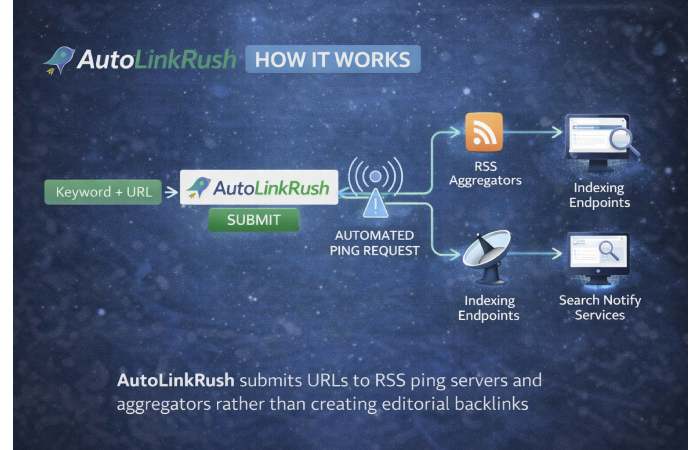
The process is simpler than most users expect:
- Enter your target URL — the specific page you want to rank
- Add your target keyword — the search term you want to show up for
- Click Generate — the system submits your link to over 1,000 ping services, indexers, web directories, and backlink sources
- View the report — a list of URLs where your link was reportedly placed becomes available within seconds
The platform also allows you to control anchor text variety (branded, exact-match, partial-match, or generic) and manage link acquisition speed to avoid sudden spikes that look unnatural to search engines.
Some paid tiers offer real-time analytics showing whether submitted links are being indexed and how they are affecting rankings. The discussion of off-page SEO provides context for activities that take place beyond a website’s own pages.
Features at a Glance
| Feature | Details |
|---|---|
| Backlink Volume | 1,000+ submissions per run |
| Anchor Text Control | Branded, generic, exact match, partial match |
| Niche Filtering | Filter by content category/topic |
| Link Velocity Control | Manage speed of link acquisition |
| Analytics | Track link indexing and performance |
| Ease of Use | No downloads, no technical skills required |
| Free Plan | Available with limited backlinks |
| Paid Plans | Faster indexing, more volume, advanced analytics |
The Real Benefits of AutoLinkRush
Speed at scale. Manual link building for even a single competitive keyword can take months of outreach, follow-up emails, and relationship building. AutoLinkRush compresses that significantly.
Cost efficiency. Agency-grade link building at volume is expensive. For smaller sites or early-stage campaigns, an automated platform offers a way to build link signals that would otherwise be cost-prohibitive.
Consistent execution. Human outreach is inconsistent — people miss follow-ups and have limited hours. Automation runs whenever you need it.
Beginner accessibility. You do not need to understand technical SEO deeply to run a campaign. This lowers the barrier for site owners who are still learning.
Anchor text diversity. The ability to distribute different anchor types across placements is a genuine feature — over-optimised anchor text is a documented spam signal, and this gives users some control over it.
The Risks You Need to Understand

This is the section most reviews gloss over. AutoLinkRush is not risk-free, and pretending otherwise does you a disservice.
Google’s position on automated link building is clear.
According to Google’s official spam policies, buying links, participating in link schemes, and large-scale manipulative link placement are direct violations that can result in algorithmic devaluation, manual action, or complete de-indexation.
The enforcement has become sharper, not softer.
The December 2024 and October 2025 spam updates significantly expanded the categories Google actively enforces. The October 2025 update specifically targeted AI-generated guest post farms and large-scale link schemes that had repositioned themselves as “content marketing” to avoid earlier penalties. Google’s SpamBrain system can now identify contaminated portions of a backlink profile with enough precision to devalue them without applying a sitewide penalty — meaning you may lose ranking without ever receiving a manual action notification.
Link quality is unpredictable. Ping services and directories vary enormously in quality. Some submissions land on trusted indexed sources; others go to spammy, irrelevant domains that actively harm your link profile.
Sudden volume spikes are a red flag. A site that gains 500 links in a week after acquiring almost none for months looks manipulated. AutoLinkRush’s link velocity controls help, but only if you use them consciously.
Verification is limited. The report generated after a run shows where links were submitted — but confirming whether those links are actually live, indexed, and passing value requires third-party tools like Ahrefs or Google Search Console.
Myths vs Facts About AutoLinkRush
Myth: More backlinks always means better rankings. Fact: Google evaluates link quality, relevance, and trust — not just volume. A thousand low-quality directory links from unrelated domains are often worth less than five editorial links from authoritative sites in your niche.
Myth: Automated tools are automatically penalised. Fact: Automation itself is not the violation. The violation is when the links produced are manipulative, irrelevant, or part of a coordinated scheme that distorts rankings. Used carefully with quality content, automated tools carry lower risk.
Myth: AutoLinkRush will get your site to page one fast. Fact: Backlinks are one ranking factor among many. Content quality, page experience, E-E-A-T signals, and site structure all play roles. AutoLinkRush accelerates one element — it does not replace the others.
Myth: Ping services and directories have no SEO value. Fact: Basic indexing submissions do help new content get discovered and crawled faster. Their long-term link equity value is low, but for new pages, faster indexing has practical utility.
Common Mistakes Users Make
- Using it on a brand-new site with zero content. Backlinks to thin, low-quality pages draw attention without providing any ranking benefit.
- Running maximum volume immediately. Gradual link acquisition looks natural. A sudden spike does not.
- Ignoring the anchor text settings. Defaulting to exact-match commercial anchors for every link creates an over-optimised pattern that is a well-documented spam signal.
- Treating it as the entire SEO strategy. Google’s own guidance is clear that when spammy links are devalued, any ranking benefit they previously provided is permanently lost — it cannot be regained by fixing the links later.
- Not monitoring the output. Running campaigns without checking Google Search Console for any manual action notifications or traffic anomalies means problems compound undetected.
How to Use AutoLinkRush More Safely
If you decide to use it, here is a responsible framework:
Pair it with strong content. Links to genuinely useful, well-written content are far less likely to attract penalty scrutiny than links to thin or keyword-stuffed pages.
Use it on supporting pages, not your main money pages. Test on lower-stakes URLs before using it on pages where a ranking drop would be most damaging.
Enable link velocity controls. Spread acquisition over days or weeks, not seconds.
Diversify anchor text. Use the platform’s anchor settings to mix branded, generic, and partial-match anchors. Analysts studying domains that survived recent spam updates found that branded anchors should represent at least 38% of a natural anchor profile.
Monitor with Google Search Console. Check for manual actions, crawl anomalies, and any sudden ranking shifts after each campaign.
Combine with white-hat tactics. AutoLinkRush works best as a supplement — not a replacement — for editorial link building, digital PR, and content that naturally attracts backlinks.
As industry research on Google’s evolving backlink enforcement makes clear, the sites that consistently maintained rankings through the 2024–2025 spam update cycle were those that combined some automation with a genuinely strong content and editorial foundation — not those relying on volume alone. The guide to UploadArticle SEO tools provides another set of tools to examine when organising website optimisation work.
AutoLinkRush Pricing Overview
AutoLinkRush offers a free plan with limited backlink generation — a reasonable way to test the platform before committing to a paid tier. Paid plans typically unlock:
- Turbo Mode — faster indexing speed
- Higher backlink volume — more submissions per run
- Advanced analytics — deeper insight into link performance
Exact pricing may vary. Always review current plan details on the official site before purchasing.
A Practical Example
Imagine you run a travel blog in India with a niche article on budget trekking destinations in Himachal Pradesh. The article is well-written, 2,000 words, with original photos and local insights. You use AutoLinkRush to submit it with varied anchors (“Himachal Pradesh trekking”, “budget trek India”, and your blog’s brand name) at a slow, steady pace over two weeks.
The result: faster indexing, some early backlink signals, and a small boost in crawl frequency. That is AutoLinkRush used appropriately.
Now consider the same tool used to generate 1,000 links overnight to a thin affiliate review page with no original content. That is where penalties become a real possibility.
Context and content quality are everything.
FAQs
Q: What is AutoLinkRush? AutoLinkRush is an automated online platform that generates backlinks by submitting your website URL and target keyword to hundreds of ping services, directories, and indexing platforms simultaneously.
Q: Is AutoLinkRush free? Yes, there is a free plan available with limited backlink generation. Paid plans offer faster indexing, higher volume, and advanced analytics.
Q: Is AutoLinkRush safe for SEO? It depends on how you use it. Used in moderation on quality content with varied anchor text, the risk is manageable. Used aggressively on thin pages or as your only SEO tactic, it carries real risk of Google penalties.
Q: Can AutoLinkRush get my website penalised by Google? Potentially, yes. Google’s spam policies explicitly prohibit large-scale manipulative link schemes. If the backlinks generated appear unnatural or land on low-quality sources, they can trigger algorithmic devaluation or manual action.
Q: How long does AutoLinkRush take to generate backlinks? The submission process typically completes within 30–60 seconds. However, actual indexing of those links by search engines can take days to weeks.
Q: Should I use AutoLinkRush as my only backlink strategy? No. It works best as one supporting element within a broader SEO strategy that includes quality content, natural link acquisition, and strong site structure.
Q: Does AutoLinkRush work for Indian websites? Yes, the platform is accessible globally including in India and supports any website URL and keyword regardless of language or geography.
Final Conclusion
AutoLinkRush is a real, functional tool — not a scam, but not a silver bullet either. It solves a genuine problem (the slow, labour-intensive nature of manual link building) with a fast, accessible solution. For beginners, small blogs, and time-constrained site owners, that has clear value.
The honest truth in 2026, however, is that Google’s spam detection has become sophisticated enough to identify and devalue manipulative link patterns with precision. Using AutoLinkRush without understanding its risks — and without strong content to back it up — is a gamble that can cost you rankings you spent months building.
Use it as a support tool. Pair it with quality content. Monitor your results. Keep your anchor text natural. And never treat it as a substitute for the kind of genuine, editorial backlinks that no algorithm can devalue.
Done right, AutoLinkRush can be a useful gear in your SEO engine. Done wrong, it can quietly stall the whole machine.